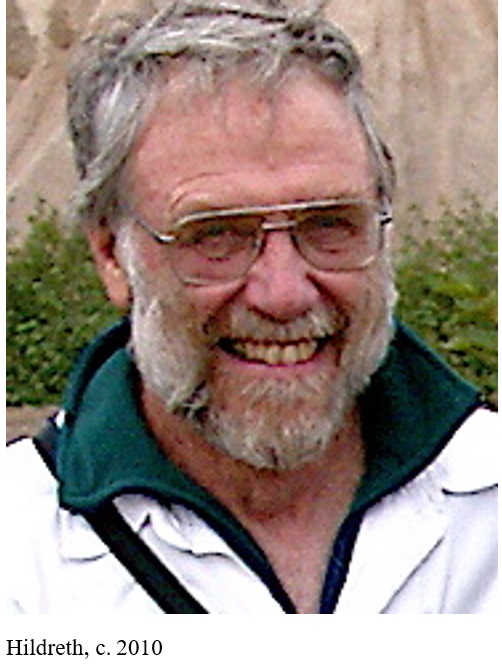
Edward Wesley Hildreth III died in an automobile accident on June 19, 2025, in Mineral County, NV. Wes was born on August 17, 1938, in Newton, MA, and was of Scottish ancestry. Wes was the son of George Hildreth, a middle-class retail store manager, and his wife Marion Fredricka Hildreth, a housewife from an upper-class family. He had siblings Deborah and Bruce Hildreth.
Wes grew up "bicoastal” and lived most of his life in either Greater Boston or the San Francisco Bay Area. He attended schools in both California and Massachusetts, and graduated in 1956 as the salutatorian of Tamalpais High School in Mill Valley, CA.
Wes attended Harvard College where he majored in geology with a minor in government. While at Harvard, he was a cross-country runner for the Harvard Crimson. After his college running career, in 1960, Wes placed 29th in the 1960 Boston Marathon. Between his sophomore and junior years, he joined an Army Reserve unit and trained for six months at Fort Ord in Monterey, CA earning the distinction "Outstanding Soldier of the Cycle" in 1959. He received a Detur Book Prize, awarded to sophomores with high academic standing in 1958 and was elected to Phi Beta Kappa in 1959. As a member of Kirkland House and the Class of 1960, Wes graduated from Harvard with an A.B. cum laude in 1961.
In 1964, Wes married Nancy Williams (now Nancy Brown, married to Roger Brown). Wes and Nancy separated in 1973 but appeared in an oral history interview together in 2016.
After graduating, Wes received Harvard's Sheldon Traveling Fellowship affording him, in his words, “a period [1961-1962] of wandering on five continents that furthered my liberation from most institutional and regional loyalties”. Wes started Harvard graduate school concentrating in government, but dropped out in 1964, turning to the outdoors as a seasonal naturalist for the National Park Service for a few years (1966-1970). Early on, Wes conducted research at Muir Woods National Monument and published a report on the history of the area.One of his duty stations included Death Valley National Park where he befriended Edward Abbey.The 1967 season was with the Park Service at Grand Canyon National Park. That year Wes became friends with Grand Canyon hikers Harvey Butchart and Colin Fletcher. With their advice, in 1968, he and Jack Fulton hiked the length of Grand Canyon National Park from Topocoba Hilltop to the Hopi Salt Trail, becoming the first people documented to make that hike. In 1969, Wes boated the Colorado River through Grand Canyon with Otis R. Marston.
Wes returned to graduate studies in the early 1970s. Under the advisership of Ian S. E. Carmichael, Charles M. Gilbert, and Herbert R. Shaw, Wes received a PhD degree from the University of California Berkeley in 1977, staying at Berkeley after graduation to complete postdoctoral work with Carmichael. He also joined the U.S. Geological Survey as a research geologist.
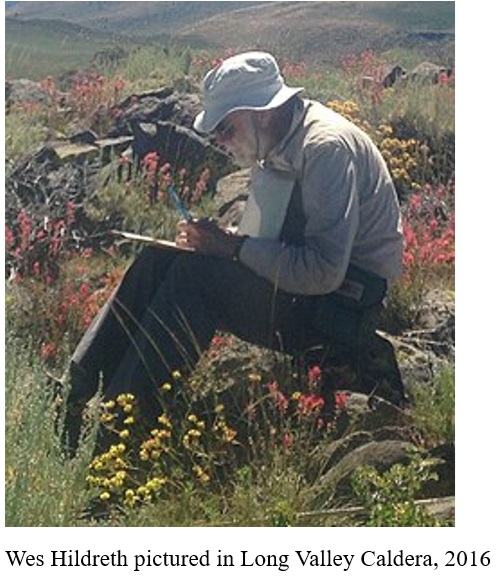
Wes’s interest in the Panamint Ranges led him to return to Death Valley and the Bishop Tuff and the Long Valley Caldera while studying at Berkeley. In 1979, Wes published the seminal paper on Bishop Tuff studies. Subsequent works by him helped establish a greater understanding of the Bishop Tuff and its origins. His analysis of the tuff was a major contribution to the field, and since that time he has published on a wide array of geoscience topics, including volcanology, petrology and geological mapping, with a focus on continental formations such as calderas. Wes collaborated with Bob Christiansen on research in Yellowstone National Park. His early research also helped solidify the scientific consensus that there is compositional zoning of magma reservoirs.
Prior to 1980, Wes’s primary research partner was David A. Johnston, though he was killed by the 1980 eruption of Mount St. Helens. After that summer, much of Wes’s research was conducted with Judy Fierstein, fellow USGS geologist. Their collaboration began in 1980, when Hildreth took Fierstein — then a fresh college graduate — to the Valley of Ten Thousand Smokes in Katmai National Park and Preserve to conduct field research. Wes had been studying the geology of Katmai since 1976, but this was Fierstein's first experience in the park. In 2012, Hildreth and Fierstein published a report to commemorate the centennial of the 1912 eruption of Novarupta. The pair had also published research on other volcanoes within the park, including Kaguyak Caldera. Their enduring partnership proved fruitful, with them both becoming vital to each other's research. Wes met Gail Mahood while a student at Berkeley, and they were married in 1982. The two were both geologists and had published papers together. Gail survives Wes.
Wes served as an associate editor of Andean Geology from 1987 to 2025, a role he previously held at the Journal of Geophysical Research from 1984 to 1986. From 1991 to 2001, he also served on the editorial board of the Bulletin of Volcanology. Wes also participated in public events — he was a participant in the 2005 GSA field forum in the Sierra Nevada and the White–Inyo Mountains. He again participated in a GSA field forum in 2009, in Bishop, CA. which was adapted into a special issue of Lithosphere. In July 2016, Hildreth and Fierstein hosted an interpretive lecture and hike at Devils Postpile National Monument.
At the time of his death in 2025, Wes was a staff member of the USGS California Volcano Observatory and worked out of Menlo Park, CA. Wes was one of the great volcanologists/petrologists of our time!!